Say what happened.
We’ll get the double entry right.
ledger.chat is an AI bookkeeper for small business. Describe a transaction in plain English, check the debit and credit legs it proposes, then approve. A real double-entry ledger sits underneath. Nothing posts without you.
No card. No per-user fees. Open-source core.
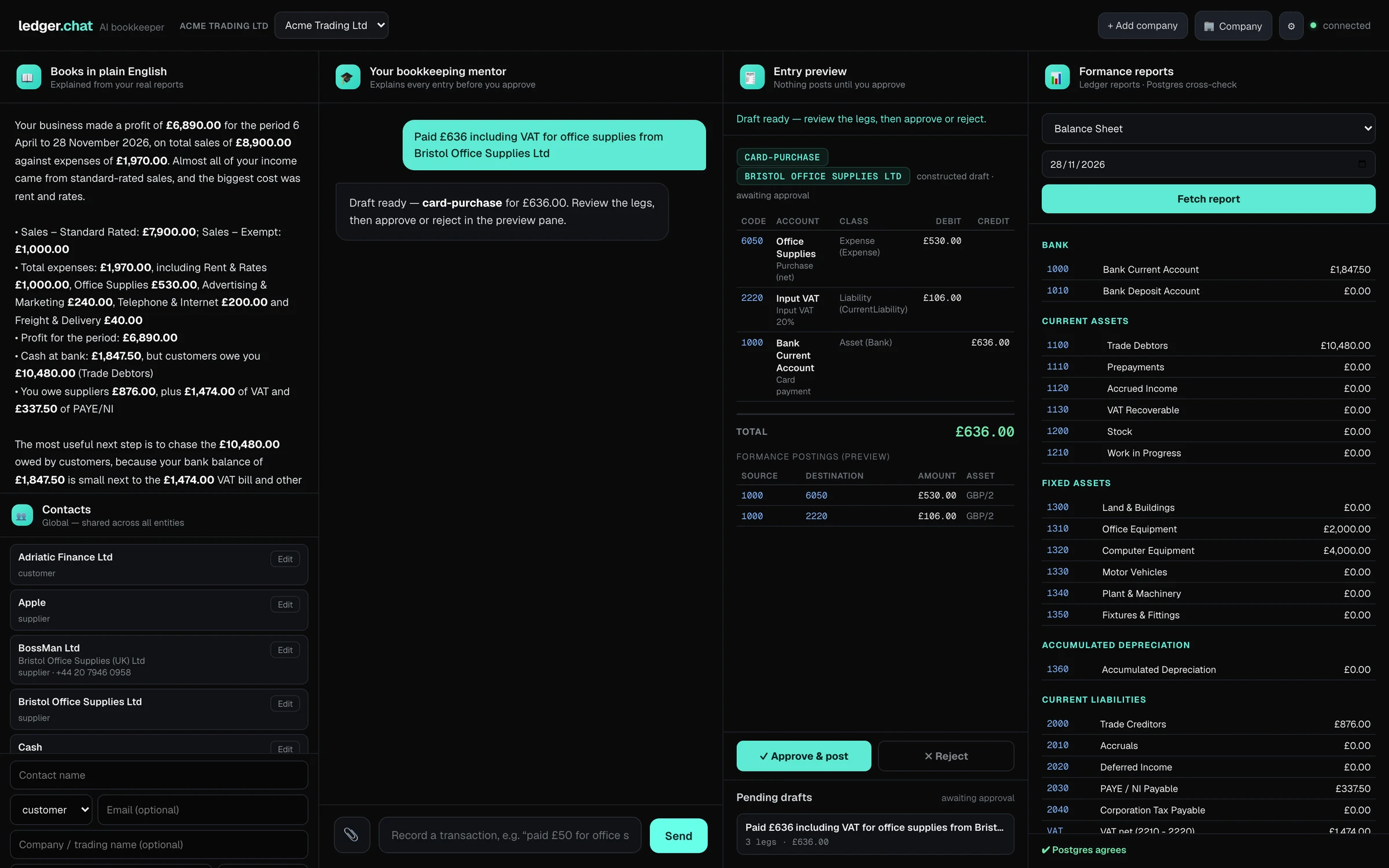
Accounting software stopped trusting you with the ledger.
Xero, QuickBooks, MYOB and Sage spent twenty years dumbing down double-entry transactions into pre-canned button transactions that limit your freedom and cause frustration. It locked down the transactions a business can actually record, and turned the one automation everyone depends on — bank reconciliations — into a toxic bio hazard.
The journal entry is hidden
Anything that doesn’t fit the template becomes a workaround, a suspense account, or a phone call to your accountant at year end.
Reconciliation roulette
Bank feeds match by guesswork. One wrong click can scramble a year of books badly enough that fixing them is its own invoice.
You pay more as you grow
Per user, per company, per module. The ledger costs the same to run whether you have two employees or twenty.
As the creator of ledger.chat, I was totally “done” with the simpler ledger philosophy at the cost of flexibility. I wanted full accounting with a simpler user experience. Why ledger.chat exists
The model never does the maths.
A large language model is a brilliant translator, but a terrible calculator. In ledger.chat the model translates your instructions into accounting language intent, then an accounting engine turns those instructions into balanced double-entry accounts. The model proposes. The ledger decides.
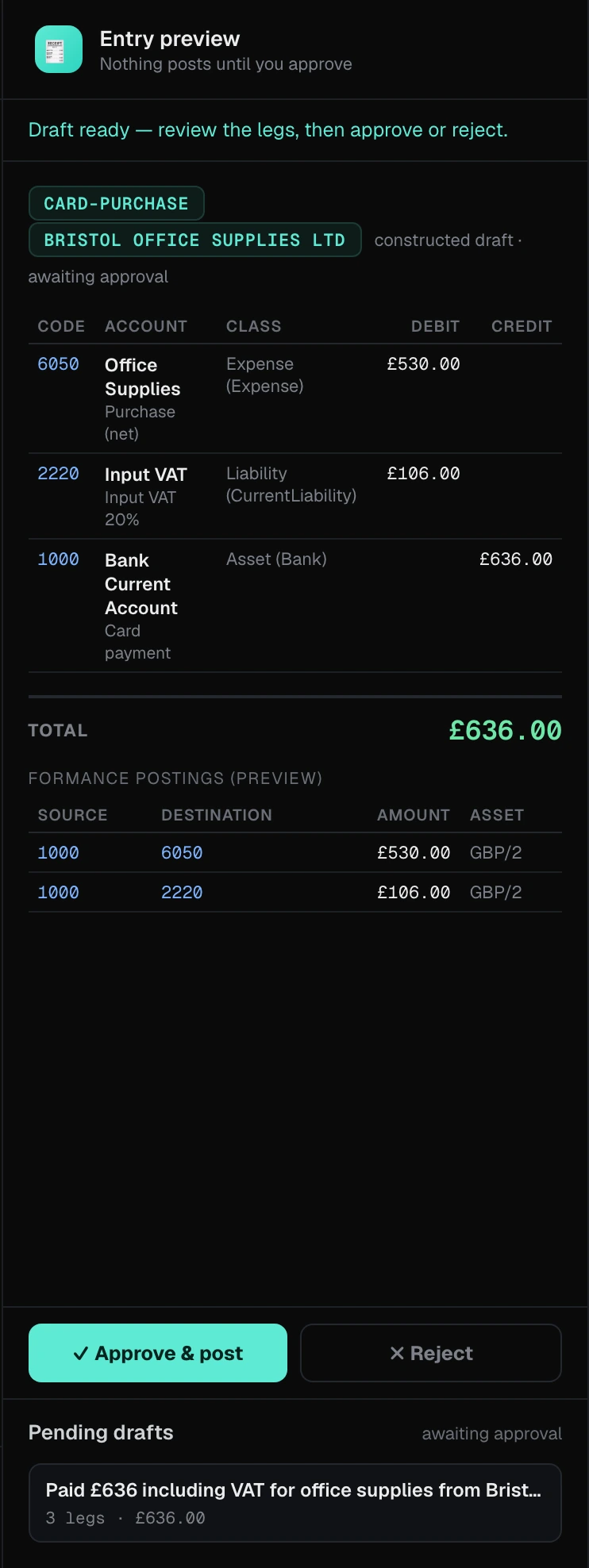
Entry preview · draft, not yet posted
Three screens, no accounting course.
The workspace is four panes wide, and only one of them asks anything of you.
Say it like a human
Type the transaction the way you’d tell a colleague. Attach the invoice or receipt if you have one; the reader pulls the totals out of the PDF.
Paid £636 including VAT for office supplies from Bristol Office Supplies LtdRead the legs before they exist
The preview shows the account code, the class, the debit and the credit. If the counterparty is missing, it asks rather than assuming.
6050 Dr £530 · 2220 Dr £106 · 1000 Cr £636Approve, and the reports move
P&L, balance sheet and trial balance come straight off the ledger. The left pane translates the numbers back into English, including what you owe in VAT and who still owes you.
✓ Approve & post → reports update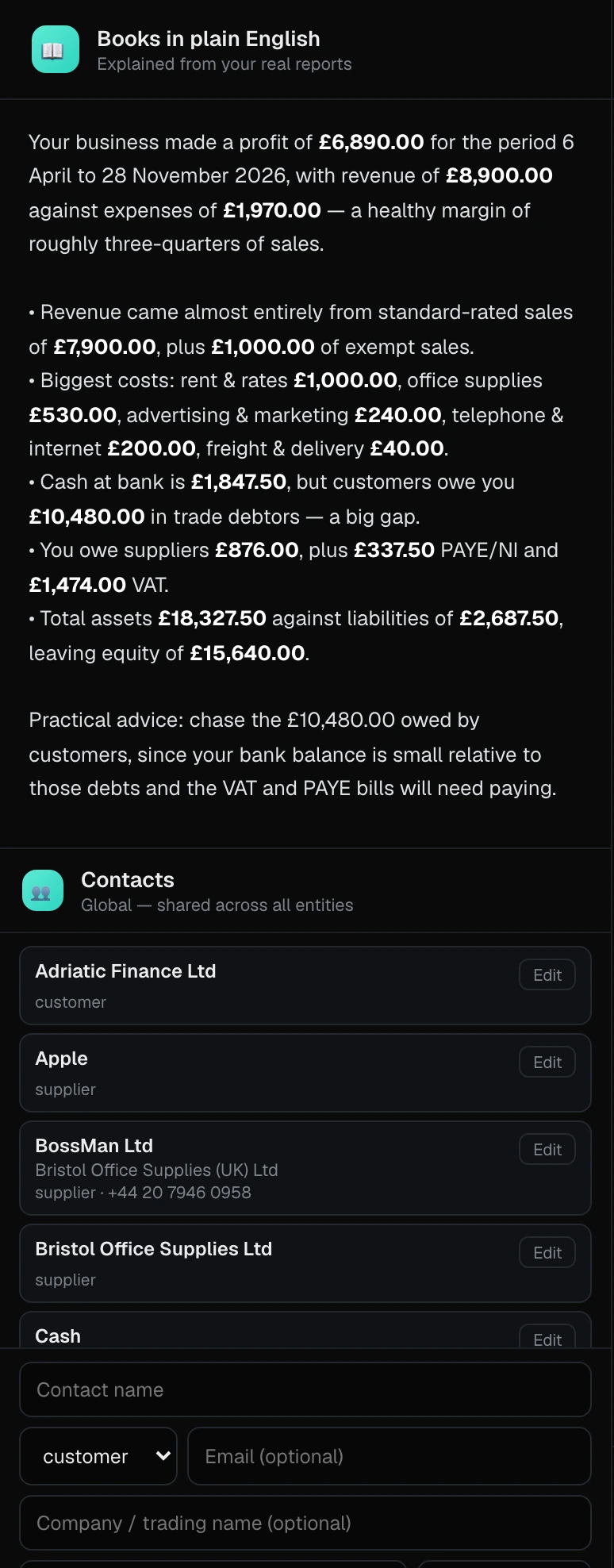
Books in plain English · read from the real reports
A full enterprise-grade accounting ledger, not a chatbot with a CRM bolted on.
Everything below runs on the same enterprise core. Features marked hosted are part of the managed cloud version; the free self-hosted build covers your day-to-day accounting requirements.
Chat bookkeeper
Transactions in plain English, explained back to you before you approve them.
Real double entry
Immutable journal entries with account codes, classes and a trial balance that ties out.
VAT on the line
Input and output VAT captured on the entry, split by rate, ready for the return.
Reports that read back
P&L, balance sheet, trial balance, cash flow, aged debtors and creditors.
Many companies, one price
Entities are scoped and switched in the top bar. You are not charged per company.
Approvals & audit
Approval tiers, self-authorised payments recorded as such, and a trail on every posting path.
Transactional memory Hosted
Remembers how you coded last time, so the tenth coffee receipt takes one glance.
Invoicing & debt collection Hosted
Send invoices, chase what’s overdue, and keep the VAT posting correct.
Reconciliations that work Hosted
Match a statement without the roulette. Unmatched lines stay visible instead of vanishing.
Agent-ready API
A documented REST API and an MCP gateway, so your own tools can read and post.
Documents in the draft
Attach a PDF or photo; the extracted text sits beside the entry it supports.
Telegram posting Soon
Post from your phone, approve from the same thread.
Simple flat fee. No per-user, per-company or per-feature pricing tricks.
Self-hosting is free forever and always will be. If you want us to run it, or to have an accountant on the other end of an email, that’s what the paid plans are for.
Self-hosted
The whole core system, on your machine, under your control.
Source-available · no licence fee
- Chat bookkeeper & entry preview
- Double-entry ledger and immutable postings
- P&L, balance sheet, trial balance, cash flow
- VAT on every line, aged debtors and creditors
- Unlimited users and unlimited companies
- REST API and MCP gateway
- You run Docker, Postgres and Formance
- You supply your own model API key
Docker Compose, your data, your backups.
Self-hosted + support
The same free core, with someone to call when an upgrade bites.
billed monthly · cancel anytime
- Everything in the free tier
- Install and upgrade assistance
- Email support, direct to the builder
- Chart-of-accounts and opening-balance review
- Backup and restore guidance
- You still run the infrastructure
For owners who like the command line, mostly.
Hosted cloud
We run the ledger, the backups and the upgrades. You run the business.
billed monthly · cancel anytime
- Everything in the free tier, managed
- Transactional memory across your chat
- Invoicing and debt collection
- Bank reconciliations that hold
- Approval workflows and audit trail
- Telegram posting when it ships
- Backups, upgrades and monitoring included
- Optional accounting support +$20/month
No per-user fee. No per-company fee. Ever.
Enter some test transactions in our live sandbox before you trust it with your own.
The sandbox is a shared demo company. Post entries, reject drafts, fetch a P&L, and see how the approval gate feels. It resets, so treat it as a playground.
The walkthrough arrives with your sandbox link.
Sandbox access
Enter your email and we’ll send the link to the shared demo. You’ll be entering transactions in a common environment alongside other testers.
- Sample company with a chart of accounts and contacts
- Every entry you draft is yours to approve or reject
- Resets periodically; don’t put real client data in it
Hosted waitlist
The managed version opens in small tranches so support stays real. Join the list and you’ll get a place before public pricing goes up.
- First access to transactional memory and invoicing
- Waitlist members keep the launch price
- Self-hosting is available today, without waiting
The questions an accountant would ask.
Does the AI see my books?
Can it post something without me?
What happens if I stop paying?
Do I need to understand double entry?
Is the sandbox safe to use with real figures?
What about HMRC and Making Tax Digital?
Your books, explained. Your ledger, intact.
Try the sandbox with invented numbers. Or take the source and run it yourself tonight.